Rapport technique FSAI-TR-2026-01
Qualité d'entrée du Face Swap, détection des visages et continuité de production : cinq études reproductibles
Cinq études limitées relient les diagnostics d'entrée, le comportement de détection des visages et les résultats mesurés de la production photo/vidéo sans les transformer en un classement de qualité non pris en charge.
Résumé
Résumé: Qualité d'entrée du Face Swap, détection des visages et continuité de production : cinq études reproductibles
This technical report consolidates five versioned FaceSwapAI studies that separate observable input conditions, face-detection behavior, and bounded production-output measurements. The studies cover 8 published reference frames, 6 controlled single-portrait degradation samples, 8 controlled group-photo sizes, 4 completed photo face-swap tasks, and 8 matched frame pairs from one 10-second production video task. The results show that successful face detection can coexist with weak preflight conditions, that detection losses appeared as the same group image was reduced, and that the two bounded production runs preserved container dimensions while returning closely aligned face boxes at the measured samples. These measurements do not establish identity fidelity, perceived realism, a universal minimum face size, a provider leaderboard, or a generation success rate. Exact inputs, outputs, hashes, formulas, datasets, and limitations remain available for inspection under CC BY 4.0.
Résultats en un coup d'œil
Résultats en un coup d'œil
- Detection and readiness diverged: all 6 controlled degradation samples returned a face box, while the low-light sample scored 53 and was rated replace.
- In the one-image group sequence, all four subjects were returned through 120 pixels wide, but one was missed at 96 pixels and no box was returned at 32 pixels.
- The four photo production pairs averaged 0.9881 face-box IoU and 0.53 pixels center displacement, with exact target-output dimensions preserved.
- The one video production pair preserved 1280 x 720, 24/1 fps, 240 frames, and 10 seconds; eight matched samples averaged 0.9884 face-box IoU.
- No reported detector, box, sharpness, or RGB measurement is presented as an identity-fidelity score, realism rating, universal threshold, or provider ranking.
Recherche et données ouvertes
Résultats en un coup d'œil
| Étude | Échantillon | Données publiées |
|---|---|---|
| Public reference-frame readiness auditv1.0.0 | 8 published photo, group-photo, video-frame, and GIF-frame references | Enregistrement JSON |
| Controlled single-portrait input degradationv1.0.0 | 6 samples derived from one public control portrait | Enregistrement JSON |
| Controlled group-photo face-size detectionv1.0.0 | 8 resizes of one four-person group photo | Enregistrement JSON |
| Controlled photo production pose studyv1.0.0 | 4 completed photo tasks: neutral, left turn, blink, and right turn | Enregistrement JSON |
| Controlled production video continuity studyv1.0.0 | 8 matched frame pairs from one synthetic 10-second, 240-frame production task | Enregistrement JSON |
Méthodes
Méthodes
The report reuses the exact versioned records rather than recomputing or selecting new observations. Each study states its input boundary, production date, measurement formulas and negative limitations. Face detection returns count and bounding boxes only; no identity embedding or recognition label is retained.
Public reference-frame readiness audit
Every original and result frame published in the four core FaceSwapAI feature comparisons on 2026-07-13.
- Longest side reduced to 360 pixels while preserving aspect ratio.
- 0.2126 * red + 0.7152 * green + 0.0722 * blue
- FaceSwapAI production public detector v1.0; count only, with no identity matching.
- Each frame is scored as a target image with FaceSwapAI Readiness Score v1.0.0.
Controlled single-portrait input degradation
Each degraded sample starts from the same public control portrait and changes one documented image property.
- Longest image side reduced to 360 pixels while preserving aspect ratio.
- Variance of a four-neighbor luminance Laplacian inside the detected face box plus 12% padding, normalized to 160x160 pixels.
- Ratio and excess of native-scale luminance differences crossing aligned 8x8 JPEG boundaries versus non-boundary neighbors inside the largest detected face box plus 25% padding.
- FaceSwapAI production public detector; count and bounding box only, with no identity matching.
Controlled group-photo face-size detection
Native image width. Every sample uses the same uncropped group photo and aspect ratio.
- sharp 0.34.5 Lanczos3 resize; JPEG quality 90; 4:4:4 chroma subsampling.
- Face count and bounding boxes only; no face crops, embeddings, identity matching or generation output.
- Returned face count divided by four visually present subjects.
Controlled photo production pose study
One synthetic source adult, one synthetic target adult, four constructed target states, and one completed production run per state.
- The production detector was run on every target and exact output; only counts and boxes were retained.
- Face-box overlap uses intersection over union, and center displacement uses Euclidean pixel distance.
- Sharpness uses normalized face-region luminance Laplacian variance; RGB MAE compares the padded face region with the remainder of the frame.
Controlled production video continuity study
A controlled, inspectable production run measuring container preservation, sampled face detection, face-box alignment and regional pixel differences across one synthetic 10-second video face swap.
- FaceSwapAI production public detector v1.0; count and bounding boxes only, with no crops, embeddings or identity comparison.
- Intersection over union between the first returned input and output face boxes at the same timestamp.
- Variance of a four-neighbor luminance Laplacian inside each face box plus 12% padding, normalized to 160 by 160 pixels.
- Mean absolute RGB difference compares matched decoded input and output frames. The face region is the union of both face boxes after 20% padding; all remaining pixels form the outside region.
Méthodes
Résultats en un coup d'œil
The controlled degradation series changes one documented property at a time. Every sample returned one box, but the readiness score and component measurements moved materially.
| Condition | Dimensions | Faces | Readiness | Face sharpness |
|---|---|---|---|---|
| Control | 720 x 1080 | 1 | 90 (ready) | 339.4 |
| Gaussian blur | 720 x 1080 | 1 | 74 (improve) | 4.8 |
| Low resolution | 180 x 270 | 1 | 66 (improve) | 74.1 |
| Low light | 720 x 1080 | 1 | 53 (replace) | 41.5 |
| Overexposed | 720 x 1080 | 1 | 72 (improve) | 678.3 |
| Heavy JPEG compression | 720 x 1080 | 1 | 78 (improve) | 311.0 |
Méthodes
Résultats en un coup d'œil
The sequence is a controlled observation of one composition, not a universal minimum-face-size rule.
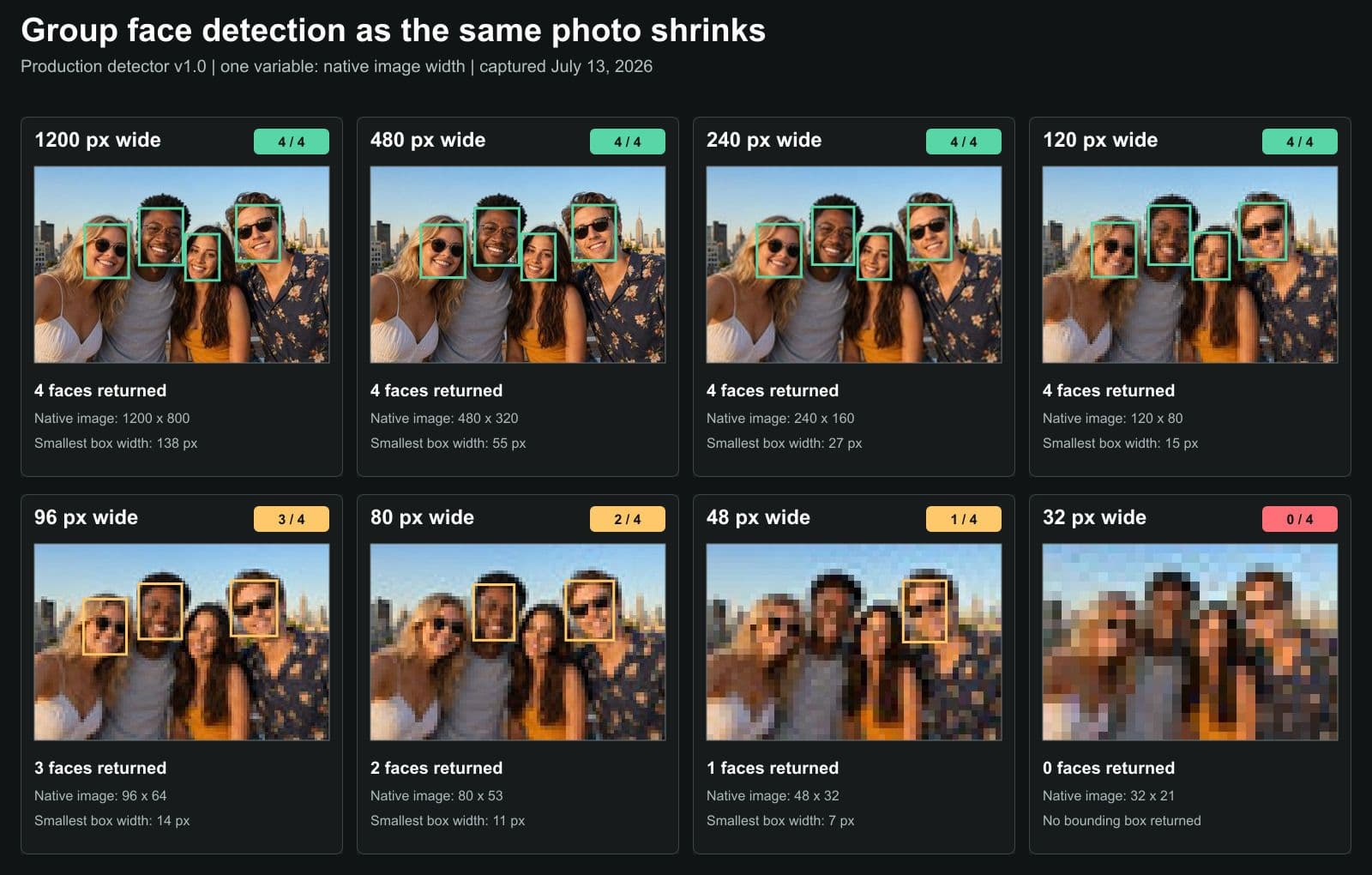
| Width | Returned | Rate |
|---|---|---|
| 1200px | 4 / 4 | 100% |
| 480px | 4 / 4 | 100% |
| 240px | 4 / 4 | 100% |
| 120px | 4 / 4 | 100% |
| 96px | 3 / 4 | 75% |
| 80px | 2 / 4 | 50% |
| 48px | 1 / 4 | 25% |
| 32px | 0 / 4 | 0% |
Méthodes
Résultats en un coup d'œil
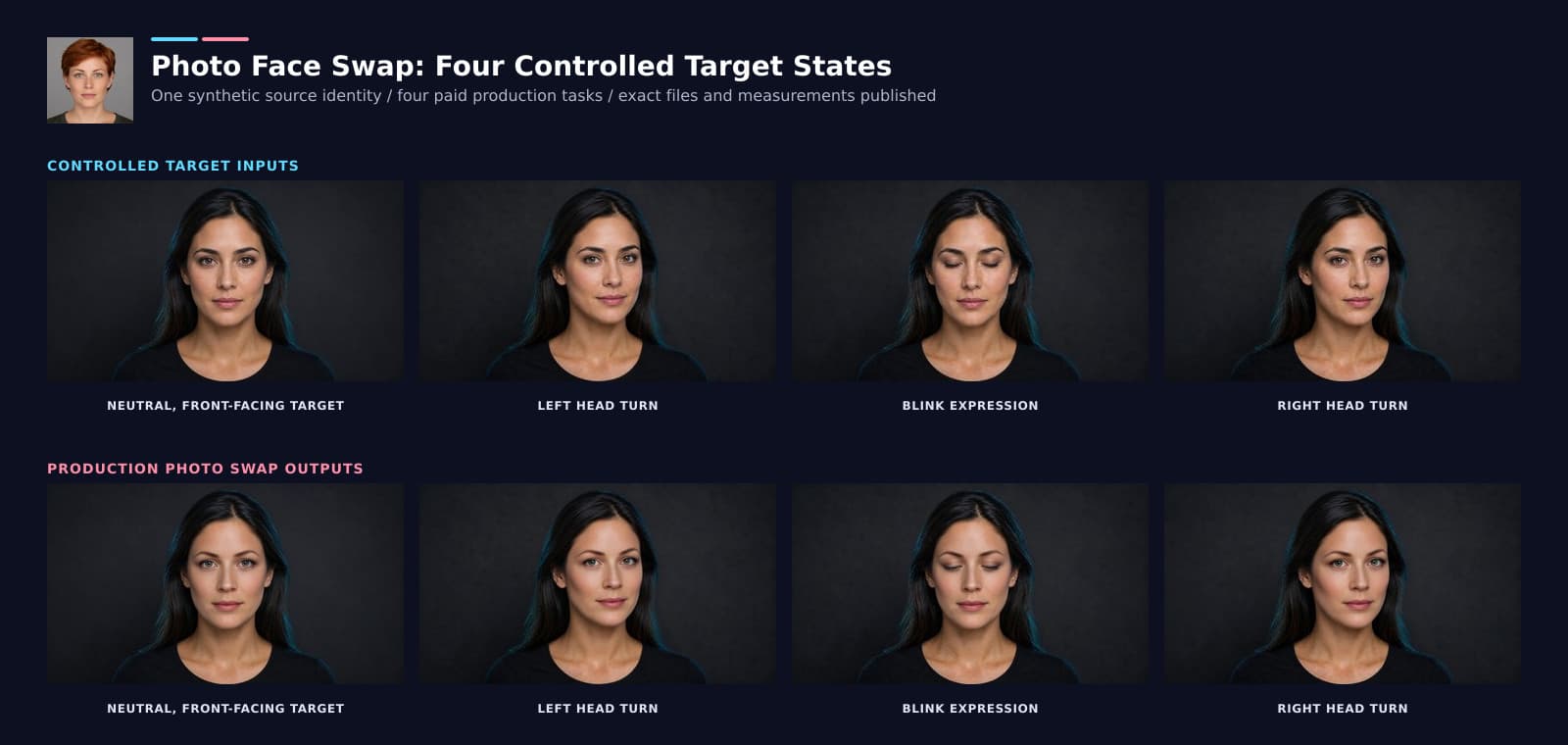
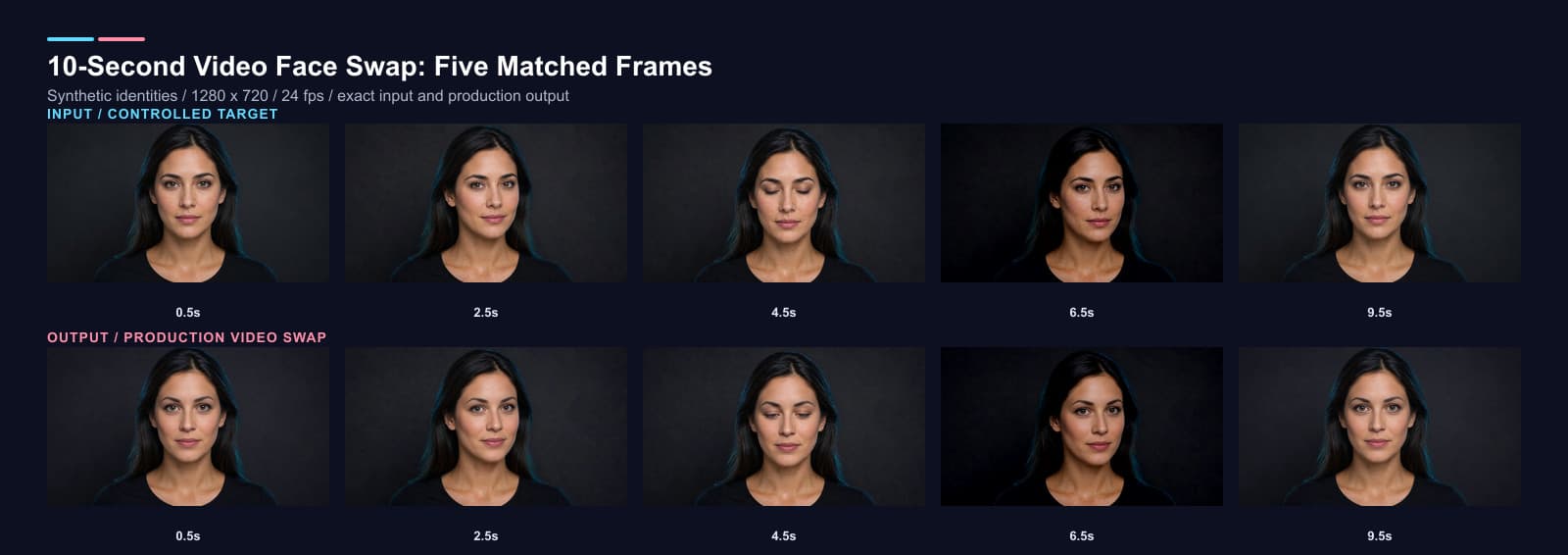
- Photo box IoU
- 0.9881 Four target-output pairs
- Photo center shift
- 0.53 px Average across four pairs
- Video box IoU
- 0.9884 Eight matched timestamps
- Video center shift
- 1.34 px Average across eight pairs
These values describe detector-box alignment at the measured samples. They do not prove identity fidelity, realistic blending, expression accuracy, or the absence of artifacts between sampled frames.
Limites
Limites
- The studies are bounded audits of public reference media and controlled synthetic adults, not population samples or demographic evaluations.
- Only the photo and video studies created face-swap outputs. The readiness, degradation, and group-size studies measured inputs and detector responses only.
- Face detection and face-box alignment do not establish identity preservation, target-attribute preservation, realism, artifact absence, or safety.
- The photo study used four tasks and the video study used one 10-second task with eight sampled frame pairs; neither is a generation success-rate estimate.
- The upstream production provider, queue, codecs, and detector can change. Future observations require a new date and dataset version rather than silent replacement.
- FaceSwapAI publishes and sells the service examined in the two production studies. Exact files, commercial disclosure, and negative limitations are retained so readers can audit that conflict boundary.
Disponibilité des données
Disponibilité des données
Every underlying dataset is public as versioned JSON. Controlled production studies also expose the exact permitted synthetic inputs and outputs with SHA-256 hashes. No private customer media or identity embedding is included.
Citation
Citation suggérée
FaceSwapAI Editorial (2026). Face-swap input quality, face detection, and production continuity: five reproducible studies. Technical Report FSAI-TR-2026-01, version 1.0.0. https://faceswapai.com/research/reports/face-swap-input-quality-production-continuity-study-2026
Rapport BibTeX
@techreport{faceswapai2026inputquality,
  author = {{FaceSwapAI Editorial}},
  title = {Face-swap input quality, face detection, and production continuity: five reproducible studies},
  institution = {FaceSwapAI Editorial},
  number = {FSAI-TR-2026-01},
  year = {2026},
  month = {July},
  version = {1.0.0},
  url = {https://faceswapai.com/research/reports/face-swap-input-quality-production-continuity-study-2026},
  note = {Open technical report and data under CC BY 4.0. PDF: https://faceswapai.com/research/reports/face-swap-input-quality-production-continuity-study-2026.pdf}
}
Divulgation commerciale
Divulgation commerciale / Divulgation commerciale
Divulgation commerciale: No external funding was received.
Divulgation commerciale: FaceSwapAI publishes and sells the service used for the two production-output studies. The report therefore publishes exact files, bounded methods, commercial disclosure, and limitations, and makes no superiority claim.
Questions fréquemment posées
Questions fréquemment posées sur le rapport
- Que mesure le rapport ?
- Il mesure les propriétés d'entrée, les zones de détection et les résultats photo et vidéo limités.
- Classe-t-il les fournisseurs ?
- Non. Un seul cycle de production n'est pas présenté comme un classement universel de la qualité.
- Les données sont-elles disponibles ?
- Oui. Les fichiers JSON, PDF et de citation sont disponibles sur cette page.
Citations de recherche et téléchargements de catalogues
- Public reference-frame readiness audit, version 1.0.0FaceSwapAI Editorial, 2026-07-13. Enregistrement JSON.
- Controlled single-portrait input degradation, version 1.0.0FaceSwapAI Editorial, 2026-07-13. Enregistrement JSON.
- Controlled group-photo face-size detection, version 1.0.0FaceSwapAI Editorial, 2026-07-13. Enregistrement JSON.
- Controlled photo production pose study, version 1.0.0FaceSwapAI Editorial, 2026-07-15. Enregistrement JSON.
- Controlled production video continuity study, version 1.0.0FaceSwapAI Editorial, 2026-07-14. Enregistrement JSON.
- FaceSwapAI readiness score methodology and versioned scoring contractFaceSwapAI Editorial, 2026-07-13. Enregistrement JSON.