Original video research
Video Face Swap Continuity Test: One Production Run, 240 Frames
Inspect one controlled 10-second production video face swap with the exact input, output, 240-frame container data, eight matched samples and public JSON.
Method, measurements and limitations reviewed against the published dataset.
 Watch the complete 10-second production output
Key takeaways
- This is the complete output of one live credit-consuming production route, not a slideshow presented as proof of natural-motion continuity.
- Input and output both contain 240 frames at 1280 x 720, 24 frames per second and exactly 10 seconds in this run.
- The production detector returned one face in every one of eight matched input and output samples.
- Matched face boxes averaged 0.9884 intersection over union and 1.34 pixels of center displacement.
- Mean RGB difference inside the padded face region was 3.02 times the outside-region value, but this localization is not an identity-accuracy score.
- The full videos, frame checksums, boxes, formulas and limitations are public so readers can inspect more than a selected before-and-after still.
Open data and method
Use the versioned source files to reproduce the table or cite the current measurement boundary.
1. The question: what can one complete production video actually prove?
Video face-swap pages frequently show a selected result frame, a short looping preview or a montage with no downloadable input. Those examples may be visually useful, but they do not let a reader verify whether duration, frame rate and frame count survived processing or inspect the moments between selected images. This study starts with a narrower question: after one controlled ten-second video is submitted to the live FaceSwapAI production route, which observable properties can be checked from the exact input and output?
The answer must stay smaller than a model review. One completed task cannot establish a success rate, compare providers or represent every face, camera and movement. A detector box cannot measure identity fidelity. Pixel differences cannot decide whether a face looks convincing. Eight samples cannot certify every one of 240 frames. The study therefore publishes the complete media first, then reports container facts, sampled detector responses and explicitly limited image measurements.
That boundary is intentional. The useful evidence is not a claim that the system never flickers. It is a reproducible record of what happened in this run, with enough information for another person to download the files, check their hashes, watch normal playback, pause on transitions and disagree with a visual judgment without disputing which files were measured.
2. Two synthetic identities and a controlled target sequence
Both portraits were created specifically as synthetic adult identities for this study. They do not depict a customer, public figure or named real person. The square source portrait supplies the identity to transfer. The landscape target states supply the black hair, head position, expression, background, framing and lighting that the output should continue to follow. No identity label, face embedding or private biometric record is stored in the dataset.
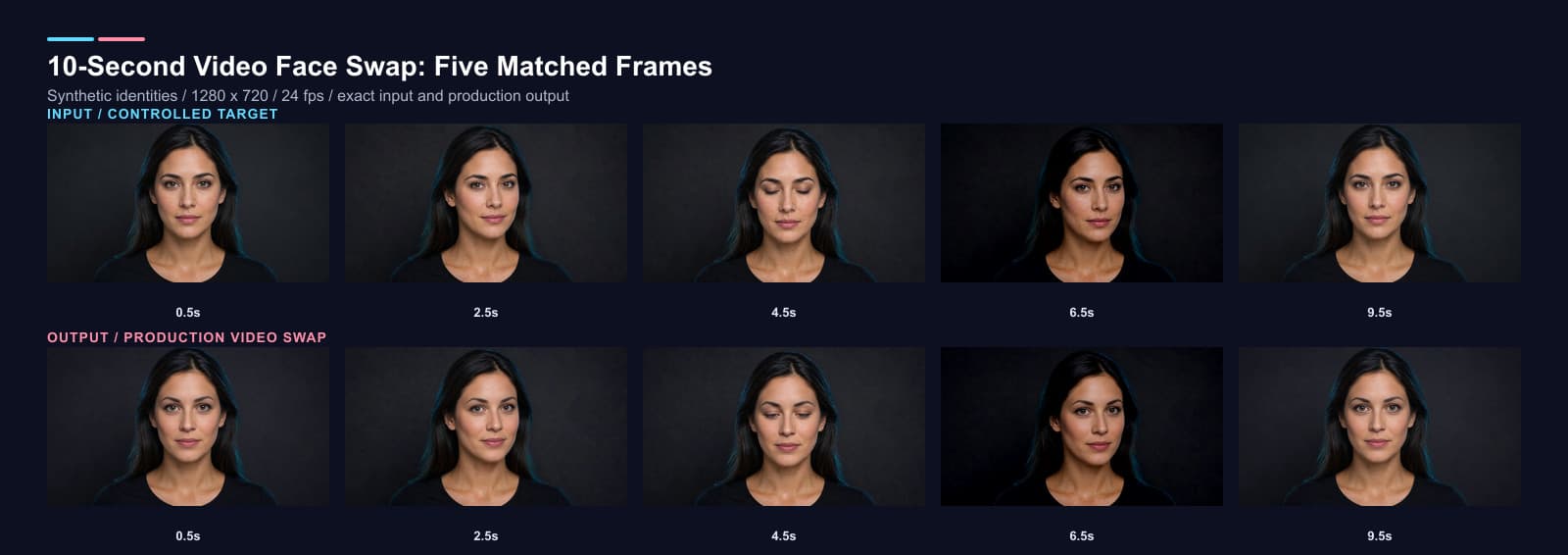
The target video is deliberately controlled rather than passed off as natural performance footage. It joins neutral, slight left-turn, blink, neutral, slight right-turn and final neutral states with documented crossfades. A small deterministic camera drift changes the crop throughout the clip, and a one-second light dip begins after six seconds. The resulting input is 10 seconds long at 24 frames per second and contains no audio stream.
A constructed sequence makes the input assets and transitions reproducible, but it also limits the claim. Crossfaded still states do not contain speech, fast head motion, hands crossing the face or motion blur from a real camera. The run tests a controlled pose, blink, crop and light sequence. A broader continuity benchmark would require multiple natural clips, identities, motion classes and independent human review.


3. Watch the exact input before interpreting the output
The production output is linked prominently above this article to a dedicated watch page. The poster link below opens a second dedicated watch page for the exact input submitted to the video endpoint. Use the same playback speed and pause at the same timestamps when comparing them. The five-pair contact sheet uses 0.5, 2.5, 4.5, 6.5 and 9.5 seconds, while the machine-readable analysis adds samples at 1.5, 3.5 and 8.0 seconds.
The expected edit region is the internal face. Target hair, shoulders, background and overall head movement are not supposed to become the source portrait. The source has red hair, but the production result retains the target black hair because a conventional face swap transfers facial identity rather than replacing the whole head. Treating unchanged hair as a failed identity transfer would evaluate the wrong product behavior.
This input is silent, so the study does not test audio extraction or merge behavior. FaceSwapAI attempts to retain original audio for videos that contain it, but a result can still be silent. No conclusion about audio preservation should be inferred from two files that contain no audio stream.
 Watch the exact 10-second input
4. The production route preserved the tested container timeline
The input was submitted to the same authenticated /api/v1/face-swap/video route documented for application users. A verified temporary test account accepted the consent requirement and paid the video formula in effect on the July 14, 2026 capture date: one credit per started second with a three-credit minimum. This ten-second task reserved and used 10 credits, reached COMPLETED and returned the output published on this page. Current video pricing is 3 credits per server-measured input second, rounded up, with a 9-credit minimum, so the same ten-second task now costs 30 credits.
After the research copy was downloaded and hashed, the temporary account, session, task record, credit log, analytics event, uploaded files and server-side result were deleted. That cleanup keeps synthetic test activity out of ongoing account and task data. The public copy remains because it is now a declared research asset rather than a private task result.
The output changed file size and pixel format, so “preserved” does not mean byte-identical. It means the selected timeline properties match: dimensions, nominal frame rate, frame count and duration. This observation is specific to the tested H.264 input and completed output; it is not a guarantee for every accepted container or provider response.
| Property | Input | Production output | Observed relation |
|---|---|---|---|
| Dimensions | 1280 x 720 | 1280 x 720 | Match |
| Frame rate | 24/1 fps | 24/1 fps | Match |
| Frame count | 240 | 240 | Match |
| Duration | 10.000 seconds | 10.000 seconds | Match |
| Codec | H.264 | H.264 | Match |
| Pixel format | yuvj420p | yuv420p | Changed |
| File size | 956,633 bytes | 1,329,222 bytes | Changed |
5. Eight matched samples kept one detectable face in the same region
Eight input-output frame pairs were decoded at fixed timestamps and sent independently to the production public face detector. Every request returned exactly one face. The detector exposes only count and bounding-box coordinates; it does not return a face crop, identity embedding, identity name or similarity score.
For each matched pair, intersection over union compares the input and output face boxes. A value of one would mean identical rectangles. The eight values range from 0.9824 to 0.9975 and average 0.9884. Box centers differ by an average of 1.34 pixels in a 1280 by 720 frame. These values show that the detector located a face in nearly the same place after processing. They do not show whether that face resembles the source identity.
Face-region sharpness was also measured after padding each returned box by 12 percent and normalizing the crop to 160 by 160 pixels. The sampled average moved from 299.44 in the input to 279.80 in the output. The values are useful as a decoded-edge snapshot, not a perceptual ranking: a generator or codec can change edge energy without making a result categorically better or worse.
| Time | Input faces | Output faces | Box IoU | Center shift | Input / output sharpness |
|---|---|---|---|---|---|
| 0.5 s | 1 | 1 | 0.9831 | 1.50 px | 336.5 / 318.9 |
| 1.5 s | 1 | 1 | 0.9918 | 1.12 px | 337.0 / 306.5 |
| 2.5 s | 1 | 1 | 0.9897 | 1.50 px | 309.3 / 285.4 |
| 3.5 s | 1 | 1 | 0.9882 | 0.00 px | 307.3 / 296.8 |
| 4.5 s | 1 | 1 | 0.9824 | 2.12 px | 261.8 / 252.3 |
| 6.5 s | 1 | 1 | 0.9880 | 2.50 px | 274.3 / 238.1 |
| 8.0 s | 1 | 1 | 0.9861 | 1.50 px | 239.1 / 243.5 |
| 9.5 s | 1 | 1 | 0.9975 | 0.50 px | 330.2 / 296.9 |
6. Decoded pixel changes were concentrated around the face
For each timestamp, the analysis takes the union of the input and output face boxes, adds 20 percent padding and treats that rectangle as the face comparison region. It then calculates mean absolute RGB difference between the matched decoded frames inside that rectangle and across every remaining pixel. The average face-region value is 3.60 on an eight-bit channel scale; the average outside-region value is 1.21.
The resulting 3.02 ratio supports one limited statement: decoded input-output differences are more concentrated around the detected face than elsewhere in these sampled frames. It does not prove that all non-face pixels are semantically unchanged. H.264 re-encoding, chroma conversion and small luminance shifts affect the complete frame, and the padded rectangle includes hair and nearby background as well as facial pixels.
A second threshold counts pixels whose mean RGB difference is at least 12. An average of 5.07 percent of pixels inside the padded region cross that threshold, compared with approximately 0.001 percent outside. Again, localization is not correctness. A badly edited face could also produce a face-concentrated difference. The complete videos remain the required perceptual evidence.
7. How to inspect video face-swap continuity without inventing a score
Start at normal playback speed because distracting temporal changes are experienced in motion. Watch the eyes through the blink, the jaw and cheek boundary during each pose transition and the face during the light dip. Then replay at reduced speed or step frame by frame around 2.0 to 2.5 seconds, 4.3 to 4.8 seconds, 5.6 to 6.1 seconds and 7.6 to 8.1 seconds, where the controlled states crossfade.
Compare the output with the input rather than judging the output alone. Ask whether target gaze, expression, head position and light timing remain coherent; whether source identity is visible; whether boundaries move independently of the target; and whether the background or hair changes when it should not. Keep those judgments separate. A stable boundary does not guarantee strong identity, and recognizable identity in one frame does not guarantee stable playback.
For your own paid run, begin with a short representative section before committing a long clip. Choose a source with a clear face and a target where the face remains visible at a useful scale. Video is priced at 3 credits per server-measured input second, rounded up, with a 9-credit minimum, so a ten-second diagnostic costs 30 credits. The studio displays the exact requirement before submission, and if a task fails on our side, its credits are refunded automatically, once.
8. Reproduction files, versioning and limits
The JSON records both video SHA-256 values, source and target asset hashes, all eight decoded frame hashes, face boxes, luminance values, face sharpness, box overlap, center displacement and regional difference values. A downloaded file that produces a different hash is not the measured version. The dataset is released under CC BY 4.0 so results can be cited with the study name, version, capture date and page URL.
Version 1.0.0 is an immutable snapshot. If the production provider, target construction, source portrait, detector response or measured output changes, the correct action is a new version and capture date rather than replacing the files under the old values. Search engines and readers should be able to distinguish a repeated experiment from a rewritten historical claim.
The largest limitation is scope: one synthetic target sequence, one source, one provider run and eight detector samples. The target is constructed from still states instead of natural speech or performance. The measurements do not include face-recognition similarity, landmarks, optical flow, lip synchronization, blinded reviewers or competitor outputs. This page therefore documents one production outcome and a reusable inspection method, not an absolute quality verdict.
Ready to apply the checklist to your own permitted media?
Questions this guide answers
Does this test prove that the video face swap has no flicker?
No. The complete video is published for inspection, but eight sampled pairs and detector boxes cannot prove that every one of 240 frames is free of flicker or identity drift.
Did the production output preserve the input frame rate and duration?
Yes in this run. Both files are 1280 x 720 H.264 video with 240 frames at 24 fps and a 10-second duration, although file size and pixel format changed.
Is 0.9884 face-box IoU an identity-accuracy score?
No. It means the detector returned nearly overlapping rectangles in matched input and output frames. It does not compare the source identity with the result.
Were real customers or public figures used in this study?
No. Both adult identities are purpose-built synthetic portraits, and the temporary production test account and private task records were deleted after the research assets were secured.
Does this study test video audio preservation?
No. The controlled input contains no audio stream, so the output cannot provide evidence about audio extraction or merge behavior.
Can I download the exact input, output and measurements?
Yes. The page links the complete MP4 input, complete MP4 output and versioned JSON with hashes, timestamps, boxes, formulas and limitations.