Original research
How Small Can a Face Be in a Group Photo? 8 Sizes Tested
A controlled group-photo experiment measuring how four detected faces change as the same image shrinks from 1200 to 32 pixels wide.
Method, measurements and limitations reviewed against the published dataset.

Key takeaways
- The production detector returned all four faces at 1200, 480, 240 and 120 pixels of native image width.
- The returned count fell to three at 96 pixels, two at 80 pixels, one at 48 pixels and zero at 32 pixels.
- At 120 pixels wide, the smallest returned face box was only 15 pixels wide; that is an observation, not a recommended upload size.
- The smallest face in the control was the first subject missed, but box size alone did not explain the complete disappearance order.
- A returned bounding box proves detection only and does not establish that enough detail remains for a convincing face swap.
- All eight exact JPEG inputs, detector boxes, SHA-256 checksums and method notes are published as versioned JSON.
Open data and method
Use the versioned source files to reproduce the table or cite the current measurement boundary.
1. The question: when does a group detector start missing people?
Group-photo face-swap pages often advise users to avoid tiny faces, but tiny is rarely defined. Product claims about supporting four, five or ten people answer a different question: the maximum number a workflow accepts after detection. They do not show whether every visible person will actually receive a selectable box in a wide or heavily reduced group image.
This study asks a narrow, reproducible question. If the same four-person photo is resized to progressively smaller native widths, how many bounding boxes does the current production detector return? Because the people, crop, lighting, pose, accessories and background remain unchanged, the sequence makes the effect of downscaling inspectable without mixing unrelated photos.
The test measures detection, not face-swap quality. It creates no generation task, spends no credit and does not compare identity or realism. A visible subject can be detected while containing too little useful detail for a clean result, so every finding below must stay inside that boundary.
2. Eight exact inputs derived from one public group photo
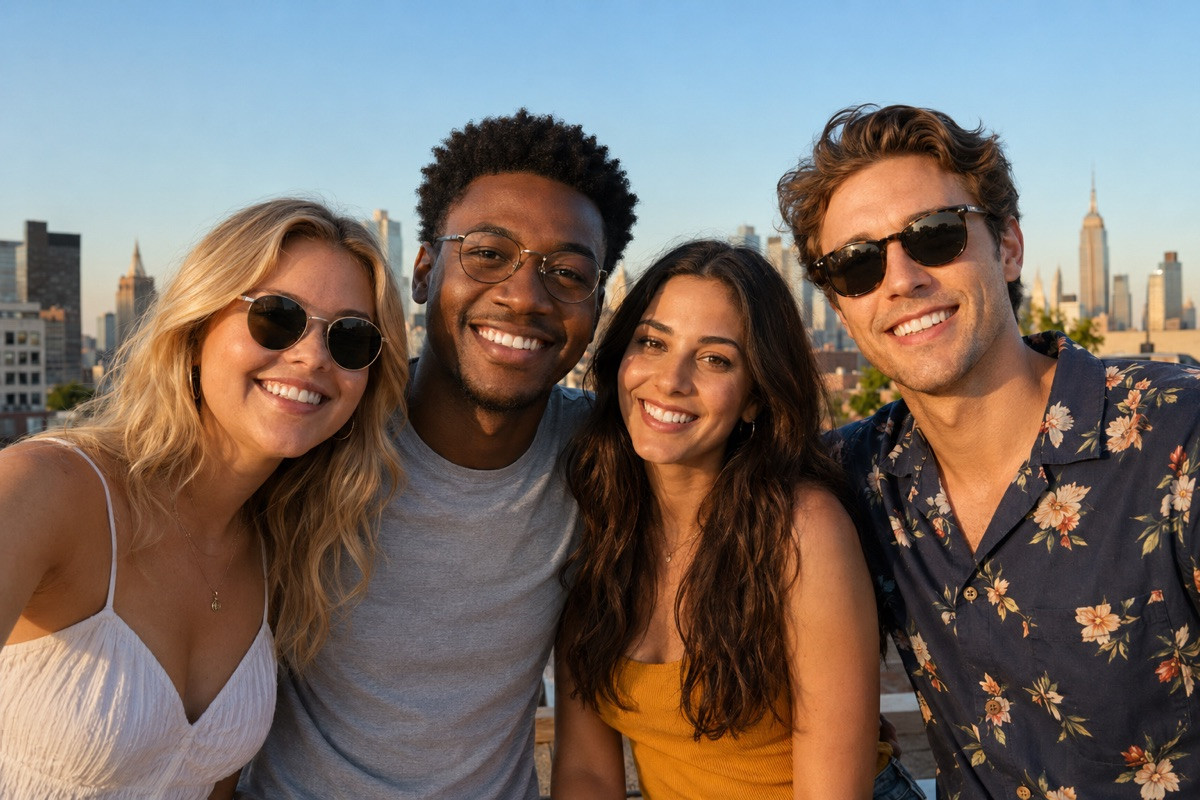
The source is the 1200 by 800 JPEG already used in FaceSwapAI’s public multiple-face comparison. It contains four clearly visible people. Eight uncropped copies were encoded at widths of 1200, 480, 240, 120, 96, 80, 48 and 32 pixels with the original three-to-two aspect ratio preserved.
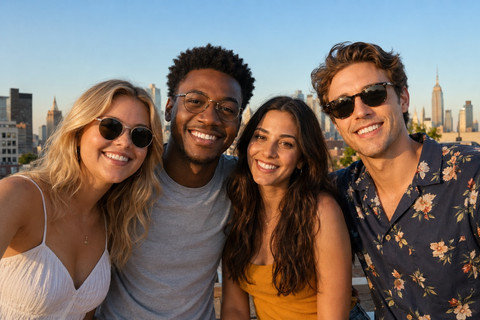
Sharp 0.34.5 performed each Lanczos3 resize. Every output used JPEG quality 90 and 4:4:4 chroma subsampling, so the deliberate sequence changes native dimensions while keeping the encoder settings fixed. The cards below are the exact files sent to the detector, not screenshots reconstructed after measurement.




3. Results: the first miss appears between two tested widths
All four subjects received boxes in the first four samples. The 120-pixel-wide image is the smallest tested sample with a complete four-of-four return. At 96 pixels, the count becomes three. This brackets the first miss between those tested widths for this exact composition and detector snapshot; it does not prove that every group image has the same breakpoint.
The count then falls monotonically across the remaining samples: two boxes at 80 pixels, one at 48 pixels and none at 32 pixels. Across all eight requests, the detector returned 22 boxes out of 32 visually expected observations. The table includes the smallest box actually returned in each request, not an estimated face size for subjects that were missed.
| Native image | Returned | Detection rate | Smallest returned box | File size |
|---|---|---|---|---|
| 1200 x 800 | 4 of 4 | 100% | 138 px | 277,218 bytes |
| 480 x 320 | 4 of 4 | 100% | 55 px | 58,201 bytes |
| 240 x 160 | 4 of 4 | 100% | 27 px | 18,577 bytes |
| 120 x 80 | 4 of 4 | 100% | 15 px | 5,922 bytes |
| 96 x 64 | 3 of 4 | 75% | 14 px | 4,182 bytes |
| 80 x 53 | 2 of 4 | 50% | 11 px | 3,316 bytes |
| 48 x 32 | 1 of 4 | 25% | 7 px | 1,532 bytes |
| 32 x 21 | 0 of 4 | 0% | No box | 981 bytes |
4. What the disappearance order reveals
The third subject from the left has the smallest control box: 38 pixels wide versus 177 to 179 pixels for the other three. That subject is also the first one absent at 96 pixels. This is consistent with face scale mattering because the already smaller region reaches the low-detail range before its neighbors as the whole scene shrinks.
Scale is not the only visible factor. At 80 pixels, the detector keeps the second and fourth subjects while dropping the first and third. At 48 pixels, only the fourth remains. The surviving people do not follow a simple left-to-right order, and accessories alone do not explain the pattern because both the first and fourth subjects wear sunglasses while only the fourth survives the smallest nonzero sample.
The defensible interpretation is that face size, local contrast, pose, feature visibility and surrounding pixels interact inside detection. A single minimum-pixel rule would overstate what this one sequence proves. The useful product behavior is therefore to show the actual returned boxes before charging for a multi-face task, not to assume that a file-level resolution label guarantees every person was found.
5. What to do when one group member is not detected
Start with the original camera file rather than a chat thumbnail or screenshot. Open it at full size and inspect the person who is missing. If the eyes, nose and mouth occupy only a few pixels, enlarging that reduced copy cannot recreate the removed facial information. Recovering the higher-resolution source is more useful than repeatedly submitting the same thumbnail.
If the original is available but the important people occupy a small part of a wide scene, crop closer while retaining everyone who must be edited. Cropping gives those faces more of the submitted pixel grid without inventing detail. Run detection again and confirm that every intended person has a box before selecting faces or starting generation.
A successful four-of-four return is still only the first gate. Inspect sharpness, head angle, occlusion and lighting for each selected face. The readiness checker can expose file-level and face-region risks without creating a generation task, while the multiple-face studio lets you verify the actual selections used by the production workflow.
6. Reproduction data and measurement boundary
Each public sample has a recorded native width, height, byte length and SHA-256 checksum. The JSON also stores every returned x, y, width and height value. Those fields make it possible to verify that a downloaded asset is identical to the measured input and to redraw the boxes shown in the overview figure.
Measurements were captured directly from the production detection service on July 3, 2026. The public readiness endpoint uses the same detector contract and strips the response to count and boxes. No crop, biometric embedding, identity label or private user file is part of the dataset.
The overview image scales each raw input into a common panel so the loss of detail can be inspected visually. That visualization is derived from the stored inputs and boxes; it is not an additional detector sample. Use the downloadable JPEGs and JSON, rather than pixels from the overview, when reproducing the requests.
7. Limits, versioning and claims this dataset cannot support
One staged photo cannot represent crowd scenes, children, older adults, every skin tone, every camera, profiles, masks, motion blur or mixed indoor lighting. The subjects here are relatively close, unobstructed and photographed in stable daylight. A different composition can lose boxes sooner or later even at the same native width.
Downscaling changes both image dimensions and recoverable facial detail. This design deliberately measures their combined practical effect and does not separate internal detector resizing from lost source pixels. It also does not run the face-swap provider, so no accuracy, realism or generation-success percentage can be inferred.
The snapshot is immutable at version 1.0.0. If the source asset, resize settings, detector behavior or returned boxes change, a new dataset version is required. Cite the dataset name, version, capture date and study URL, and describe the 120-to-96-pixel transition as an observation from this image rather than a universal threshold.
Ready to apply the checklist to your own permitted media?
Questions this guide answers
What is the minimum face size for multiple face detection?
There is no universal minimum proven by this study. In this one image, all four faces were returned at 120 pixels of image width, while one was missed at 96 pixels.
Does detecting all four faces mean the group swap will look good?
No. Detection only returns boxes. Identity detail, sharpness, pose, occlusion, lighting and provider behavior still affect a generated result.
Why did one small face remain detectable after others disappeared?
Returned boxes depend on more than width. Local contrast, pose, feature visibility, accessories and surrounding pixels can all affect this detector snapshot.
Can I download every measured image and bounding box?
Yes. The versioned JSON links all eight exact JPEG inputs and records their checksums, byte sizes, face counts and complete bounding boxes.
Were any private customer photos or paid generations used?
No. The study derives from one public demo image, creates no generation task and uses no customer media or credits.